A couple days ago I was doing some problem solving when I asked myself a question. What is a problem. I paused for a minute allowing myself to process and attempt to answer so I could solve the problems I was facing and continue... but I couldn't. I ended up writing on my reminders "What is a problem, like really?".
The issue doesn't stem from not being able to define it, which I wasn't able to do anyways. It comes from the realization that I'd been "solving problems" and "finding solutions" for so long that I never stopped to think. What is this "thing".
As of writing these very words I haven't solved this issue. This blog, which I am writing live will document me attempting to solve this issue.
The first thing I'm going to do is ask Siri to define "Problem".
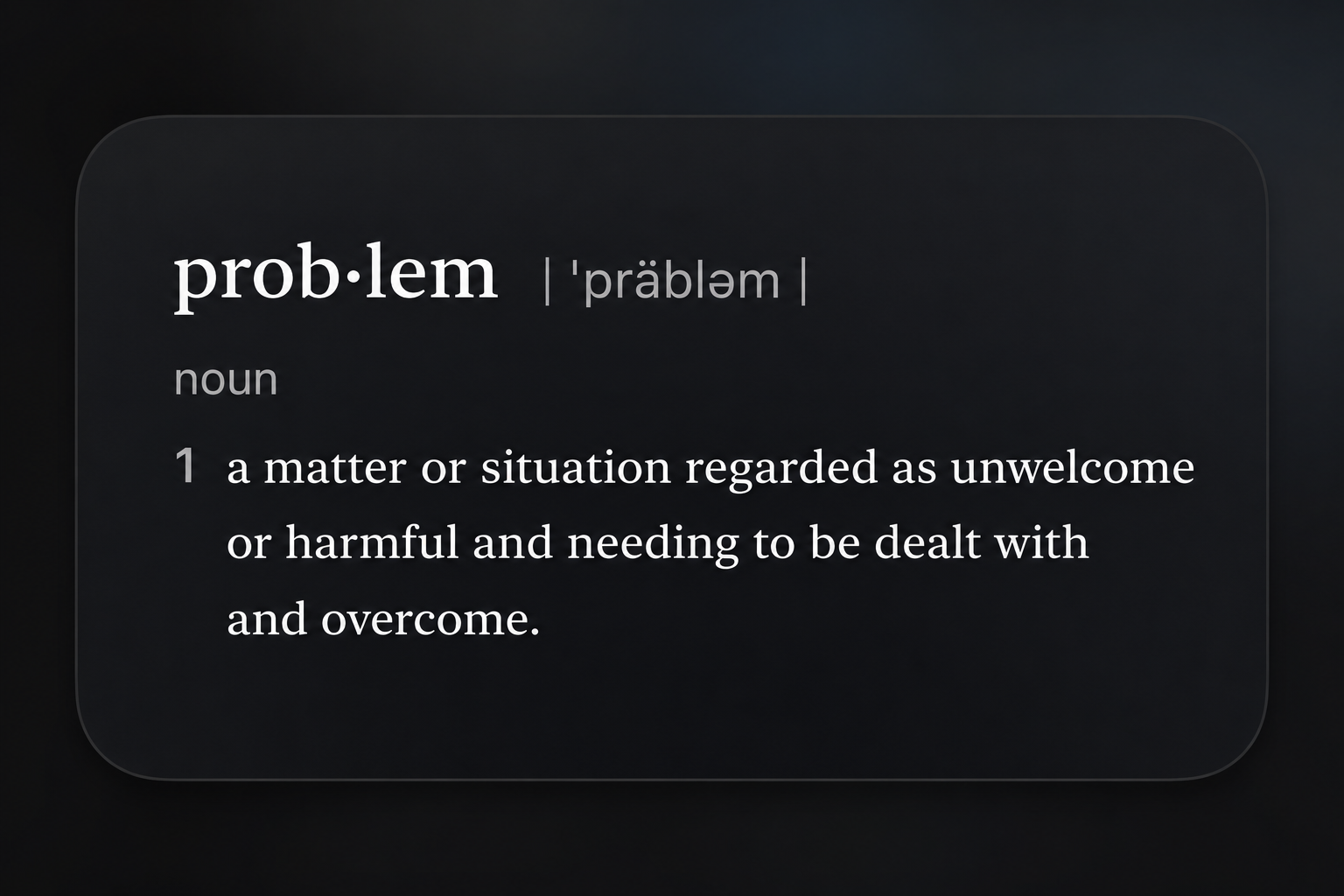
a matter or situation regarded as unwelcome or harmful and needing to be dealt with and overcome.
I'll first start off with opinions and then facts. One. I like this definition. It encompasses the undesirability of a problem and the need to solve it. I like this because people often internalize problems and end up living with them, instead of acting on them. Two. The definition makes more questions than it does answers, giving us more problems, situations that are unwanted, that will be dealt with.
Problems I've uncovered, The word "regarded" is opinionated, meaning, what is a problem to one person may not be a problem to another. A problem can be "overcome" which gives the connotation that it does not always need to be solved but maneuvered.
Yet the question still stands, what is a problem, like really? Yes, we could say, through the opinionatedness of "regarded", each person decides whether a matter or situation is unwelcome or harmful and how they intend to deal or overcome said scenario. Yet, we are still avoiding the understanding of what a problem is. The definition allows us to contextualize and characterize but not understand. It's easy to use the definition as a mathematical formula, as I did above to talk it through. But, what makes a problem a problem? How does one "regard" a matter or situation, unwelcome or harmful.
We are digging deeper now and as always it seems that the answer is philosophical. Let's briefly recap, a problem is an opinion on a situation, a problem is unwanted, and a problem is to be dealt with. Let's quickly test this hypothesis on a situation, to test its validity. I have a lot of money, I can't mange it, and i'm loosing track of it. This is the situation. In my opinion the problem is that "i'm loosing track of it". So dealing with this problem we can go upstream, to the source. "I can't manage it", so then we will find a way to manage it, yet going upstream again we find "I have a lot of money". This is the source of the issue, without having a lot of money, I wouldn't need to manage it, and I wouldn't loose track of it. So the question now is, if that isn't my problem, or somehow I don't want it to be, because in my opinion "having a lot of money is not a problem but a solution", how can it cause me problems.
Are there problems that are wanted?
If a problem is wanted then that breaks the definition.
If a symptom of having a lot of money is not being able to manage it (until dealt with), then am I saying I would like this problem?
If a symptom of riding a motorbike is being at risk of injury (which can't be dealt with), then am I saying that I'd like to be at risk?
How much can a situation encompass? Can problems be wanted? if problems are of the 4th dimension, (on the plane of time) then as a 3 dimensional being, can they ever be escaped?
I knew there were a lot of questions.
Let's recap, some situations have problems that cannot be dealt with or overcome, some solutions create problems.
What is a solution?
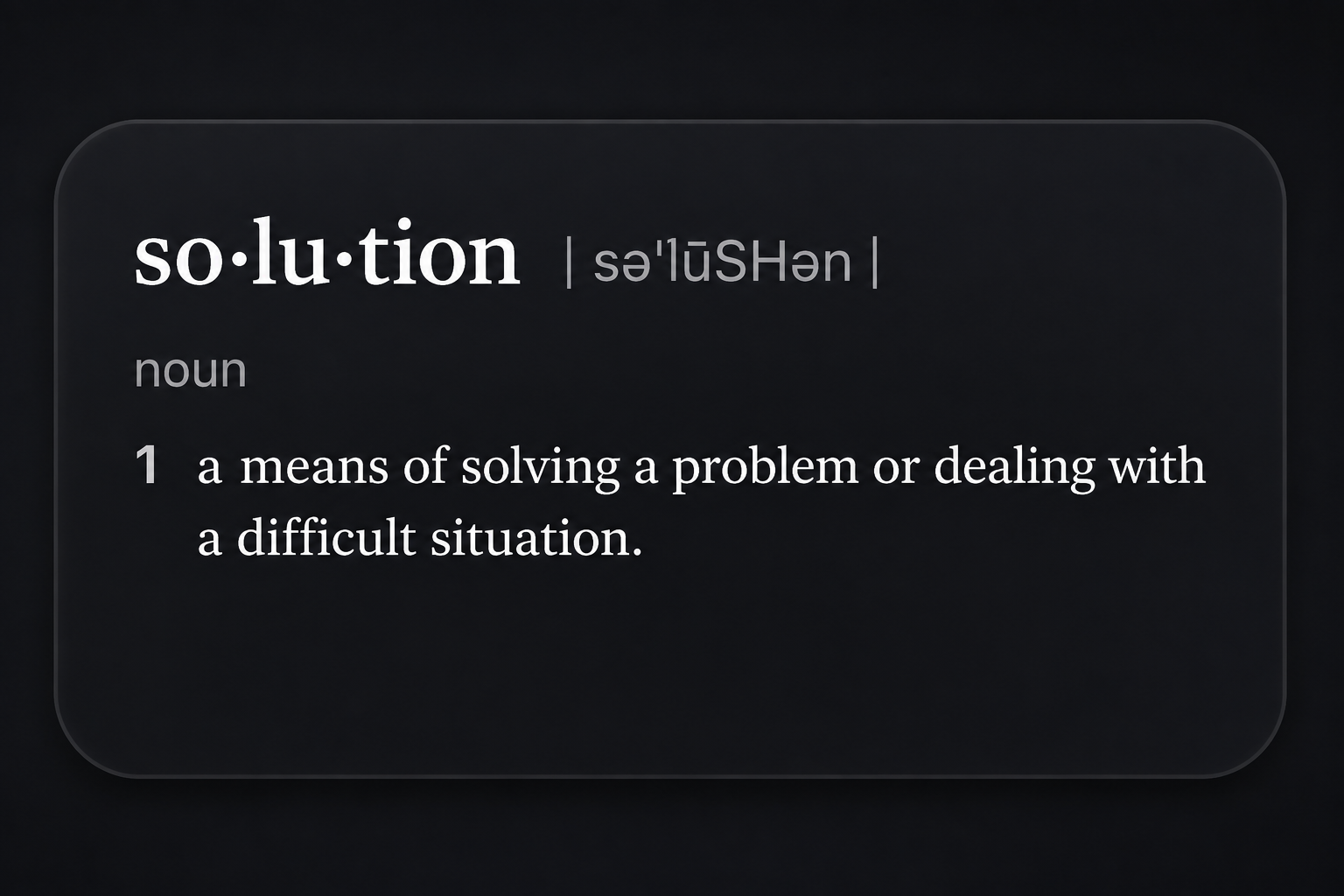
a means of solving a problem or dealing with a difficult situation
If a solution is the means of solving a problem, from our previous understandings we can understand that a solution is simply the transmutation of a problem into a different problem. This is commonly proposed but to test our hypothesis we must apply it. I have a lot of money, I can't manage it, and I'm loosing track of it. This is the situation. In my opinion the solution is "keeping track of it". So dealing with the route of this solution we can go upstream, to the source. "I can't manage it", so then we find a way to manage it. yet going upstream again we find "I have a lot of money". This is the original solution, so we must go downstream. We must find a way to manage it. To manage it, it takes me time, effort, energy, and other resources. The transmutation of one problem "Having a lot of money", becomes "expending resources to manage it" (this also solves later problems which is why we always solve at the source).
Now, we have solved the problems (created) of having too much money, yet we now have new problems, the expenditure of resources required to manage said money.
Are there problems that are wanted?
If a problem is wanted then that breaks the definition.
If a solution to having a lot of money is having to manage it (dealt with), then am i saying I would like this problem?
if a solution to riding a motorbike is not riding it, wait a minute?
how do we solve this matter, this situation.
Remember, and here lies the solution to all your problems. a problem is "regarded", opinionated. Being at risk of injury simply must no longer be "regarded" as a problem.
If it's opinionated then the problem is your thinking, and you are, not your body, or mind but your thoughts.
Another step towards unachievable perfection.
- Erik